What Happens When You Create Something Nobody Will Ever See
The Hobby That Humbled Me
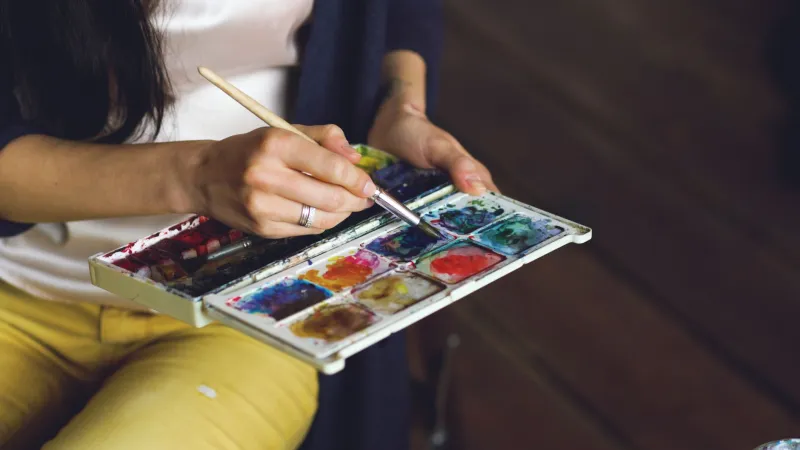
About eighteen months ago, I started taking watercolor classes at a community center on Tuesday evenings. Not a workshop with a cute hashtag. Not a content series. Just me, a folding table, some very patient retired women named Connie and Barb, and an alarming amount of paint on my forearms by the end of each session.
I am genuinely not good at watercolor. My trees look like clouds. My clouds look like sadness. My instructor, a soft-spoken woman in her sixties who has the patience of a saint, told me my color mixing had "real personality," which I'm pretty sure is art teacher for "bless your heart."
And I love it. I love it in a way I haven't loved something in years. Because nobody's watching.
The Validation Loop and How It Rewires You
If you've built any kind of career around performing — whether that's on a stage, in front of a camera, or in someone's podcast feed — you know the loop. You create something, people respond, the response shapes what you create next. Over time, the loop tightens. You stop asking "what do I want to make?" and start asking "what will land?" Sometimes those questions have the same answer. A lot of the time, they don't.
External validation isn't inherently bad. Applause is fuel. Positive comments can genuinely sustain you through difficult creative stretches. But when applause becomes the only fuel — when you can't find the motivation to make something unless there's an audience waiting for it — that's when you've got a dependency problem, not a career.
The psychological term for what we're really after is intrinsic motivation: doing something because the act itself is rewarding, not because of what it produces. Research consistently shows that intrinsic motivation leads to deeper engagement, more creativity, and greater long-term satisfaction. But here's the catch — external rewards, when introduced into something you used to love for its own sake, can actually erode intrinsic motivation over time. Psychologists call it the overjustification effect. I call it the reason I stopped enjoying karaoke after I started performing professionally.
Exercises for Finding Your Private Joy
Rebuilding a relationship with creating-for-yourself takes practice, especially if you've been audience-oriented for a long time. Here are the approaches that have actually worked for me.
Start with something you'd be embarrassed to share. This is the most useful filter I've found. If the thought of someone seeing it makes you cringe — not because it's harmful, but because it's imperfect, silly, or deeply personal — that's probably the thing you should be doing. The embarrassment is a sign that your ego isn't in the driver's seat yet.
Remove the documentation instinct. Leave your phone in another room. Don't take a photo of the finished painting. Don't film the process. Let the thing just exist without evidence. This is harder than it sounds, and the discomfort you feel is worth paying attention to.
Set a no-sharing rule for at least 30 days. Pick one creative practice and commit to not sharing any of it for a month. Journal entries, sketches, playlists you make just for yourself, a recipe you're experimenting with — keep it off the grid. Notice how your relationship with the activity changes when there's no audience at the end of it.
Revisit what you loved before anyone was watching. There was a version of you who sang in the car without thinking about pitch, who doodled in notebook margins without calling it art, who danced in the kitchen without framing it as content. That person isn't gone. They're just buried under a few years of metrics. Dig them out.
Find a class or group with no stakes. My Tuesday watercolor class works because nobody there cares about my platform. Connie and Barb are not going to leave comments. The community center doesn't have a follower count. It's just a room full of people making imperfect things together, and it's the most grounding two hours of my week.
The Unexpected Thing That Happens
Here's what nobody warned me about: when you start doing things that are purely for yourself, you actually become more interesting to your audience.
I don't say that to make this about the audience, because it genuinely isn't. But it's a real side effect worth naming. When you have a private interior life — when you're not constantly turning every experience into content — you develop a kind of depth that shows up in everything you do share. You have more to draw from. Your perspective gets richer. You stop running on fumes and start running on something that actually replenishes.
The creators who've sustained long careers, the ones who don't burn out by thirty-five and disappear — they almost all have this. A garden they tend that nobody photographs. A book club that never gets mentioned in their newsletter. A friendship that lives entirely offline. The private life isn't separate from the creative life. It feeds it.
Living Out Loud Means Choosing What to Shout
Living out loud — really living it, not just performing it — doesn't mean sharing everything. It means actually being present for your own life, including the parts of it that never make the highlight reel.
My watercolor paintings live in a stack on my kitchen counter. Some of them I've thrown away. A couple I actually like. None of them have been posted anywhere. And every Tuesday night, I drive home with paint on my arms feeling more like myself than I have all week.
That's not nothing. That might actually be everything.